On tech + democratic innovation #2
A Research Digest on Digital Deliberation

Good morning!
I’m back for the 2nd edition of this newsletter — thank you everyone who joined me on this journey and I hope to share a few interesting finds with you. This month I have papers ranging from fairness in sortition to dialogue facilitation data and language models that can generate policy statements.
As before, I summarize each paper in a few paragraphs, focusing on context, methods, takeaways, and why it matters. I also try to add interest-inducing visualizations, to nudge the viewer to read the actual paper!
In the last section, I share a few fellowships, open-calls, and similar opportunities related to democracy and tech.
AI Tools for Deliberation
Mapping LLM Tools for Public Discourse, Pluralism & Social Cohesion
Plurality Institute, The Council on Technology & Social Cohesion, Prosocial Design Network. A list of LLM tools for public discourse.
Context: This new report (it came out in October) is an overview and a taxonomy of public discourse tech, based on a convening of over seventy researchers and technologists in Berkley in February 2025. The tools are split into thematic groups: Social Media, Platforms, Deliberative Platforms, and Miscellaneous, with different MOs and goals. The aim of this report was not to make a comprehensive map of tools for public discourse, which is impossible given how quickly the field evolves, but to inspire the conversation and outline the current state of affairs.
Key take-away: It’s a wonderful source and taxonomy for anyone researching the state of the field or trying to understand how the existing abundance of tools differ from each other and how they can be connected into a pipeline.
Facilitation in the AI Era. A Community Roadmap for Technologies to Support Practitioners
Google Jigsaw.
Context: Facilitated group conversations are increasingly important for democratic and deliberative processes. This report focuses on supporting facilitation with AI tools. It was published last month.
Methods: An ethnographic study with 22 facilitators from 6 continents. They developed a roadmap of five opportunity-areas where AI might support facilitators: scaled access, dynamic learning, live sense-making, future-casting, and sense-making with participants. These tools should be co-designed with facilitators and participants.
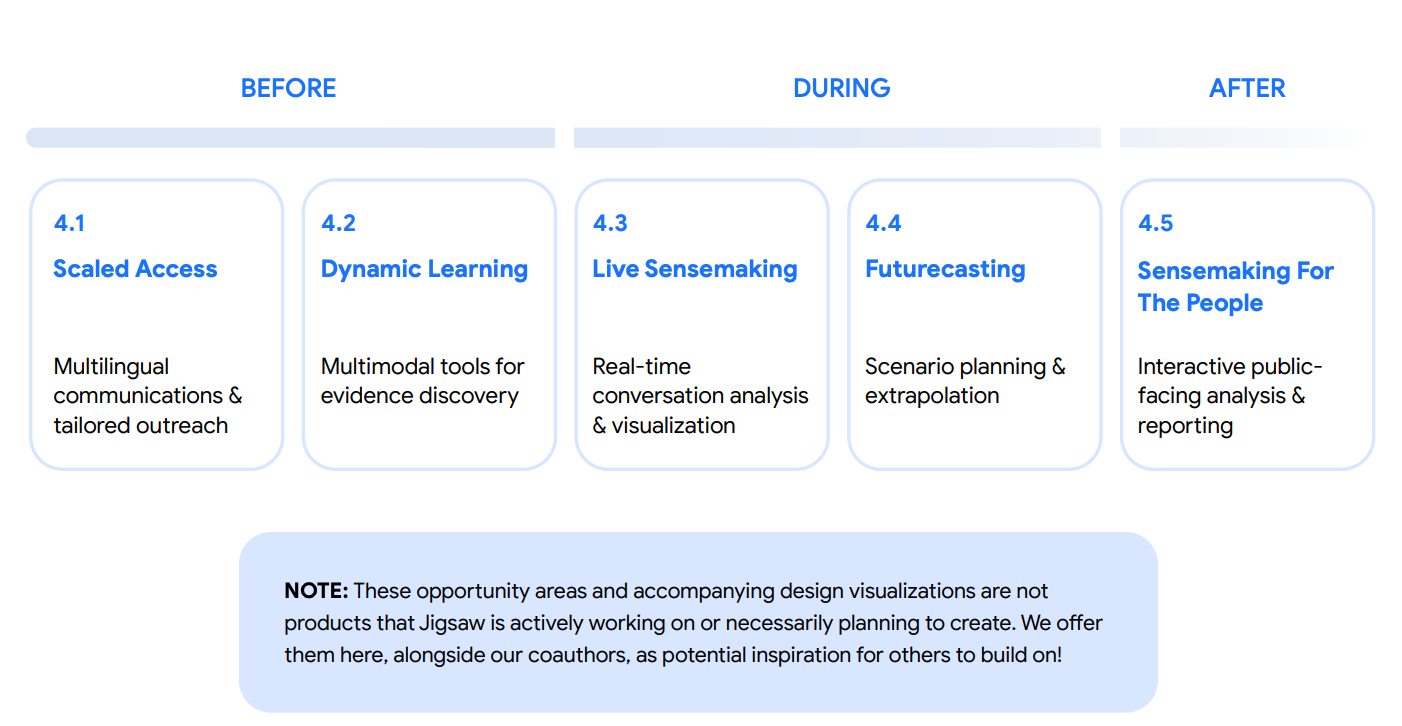
Key take-away: Practical design suggestions. What I find important in both reports, is their emphasis on working with tech and not striving to replace facilitators with LLMs. Mapping LLM Tools states that most deliberative tech tools in the dataset prioritize human-centered design and consider human agency essential to deliberation. Similarly, the Facilitation in the AI Era lists possibilities of LLMs augmenting and supporting facilitation. None of this is about taking away facilitators’ jobs, but rather about making their work easier.
Voice to Vision: A Sociotechnical System for Transparent Civic Decision-Making
Margaret Hughes, Cassandra Overney, Ashima Kamra, Jasmin Tepale, Elizabeth Hamby, Mahmood Jasim, Deb Roy.
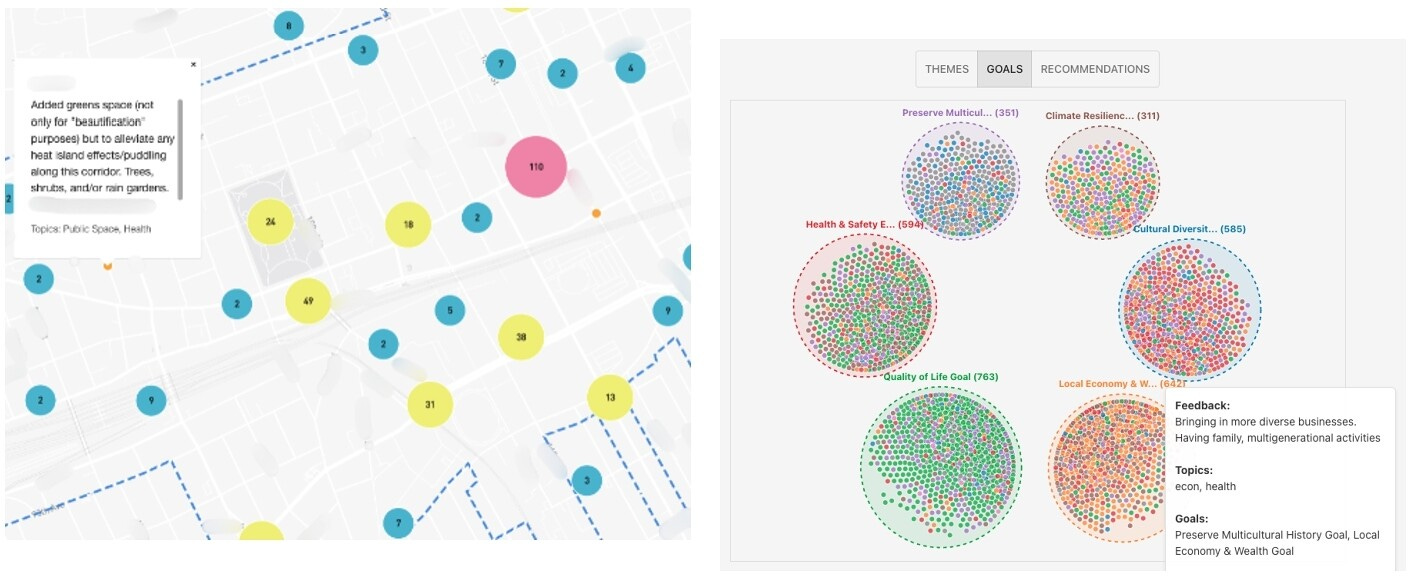
Context: Voice to Vision is a system for social sensing and turning public comments into policy. This paper outlines their data structures and the general flow of things. For more context and use examples also check out this paper. Voice to Vision was used for city planning efforts in NYC’s Jamaica neighborhood. And I’m hearing that the Jamaica Neighborhood Plan has been recently approved by the city council!
Methods: In addition to presenting the tool, this paper discussed structured interviews with urban planners (N=7) and community members (N=17). Interviewees valued Voice to Vision’s sense-making capabilities, but noted the tension between summarizing information and supporting deeper exploration.
Why it matters: Useful to those working with unstructured community input & speech.
Modeling Conversations and Collective Preferences
Fora: A corpus and framework for the study of facilitated dialogue
Hope Schroeder, Deb Roy, Jad Kabbara.
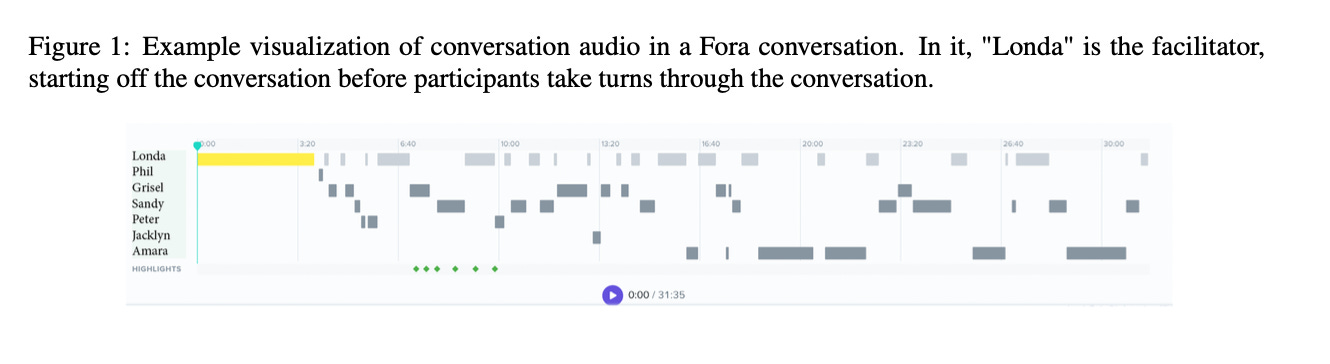
Context: this paper introduces a corpus 262 facilitated conversations (39,911 speaker turns). These conversations were organized with various US-based organizations that partnered with the non-profit Cortico. Community members and stakeholders were invited to share their perspectives on topics like education, public health, and upcoming elections. This dataset can be requested here.
Methods: Conversations occurred between November 2019 and April 2023. Each collection is matched to a conversation guide that facilitators used for the conversation. 25% of the corpus is annotated by humans: they labeled the key sharing behaviors and facilitation strategies.
Their approach to making sense of this data is also notable: first, they apply Gini coefficient to look into time-sharing inequalities, using speaking turn count and speaking duration. Next, they distinguish two types of personal sharing by participants, and seven techniques used by facilitators, which they then annotate manually (by the way, check out this library for annotation), and then apply an annotation pipeline with GPT-4.
Why it matters: Super valuable data for anyone tweaking LLMs for facilitation or working on text and conversation analysis.
Generative Social Choice
Sara Fish, Paul Gölz, David C. Parkes, Ariel D. Procaccia, Gili Rusak, Itai Shapira, and Manuel Wüthrich.
Context: Traditional social choice theory assumes people choose from a fixed list of options. The authors note that policy debates are often not a choice between well-defined options, and that we often work with open-ended questions, unforeseen alternatives, and emerging statements. This paper introduces “generative social choice”: a way to combine social choice theory with language models so that collective decisions can include generating text. The goal is to design fair, representative group decisions when possible choices are open-ended.
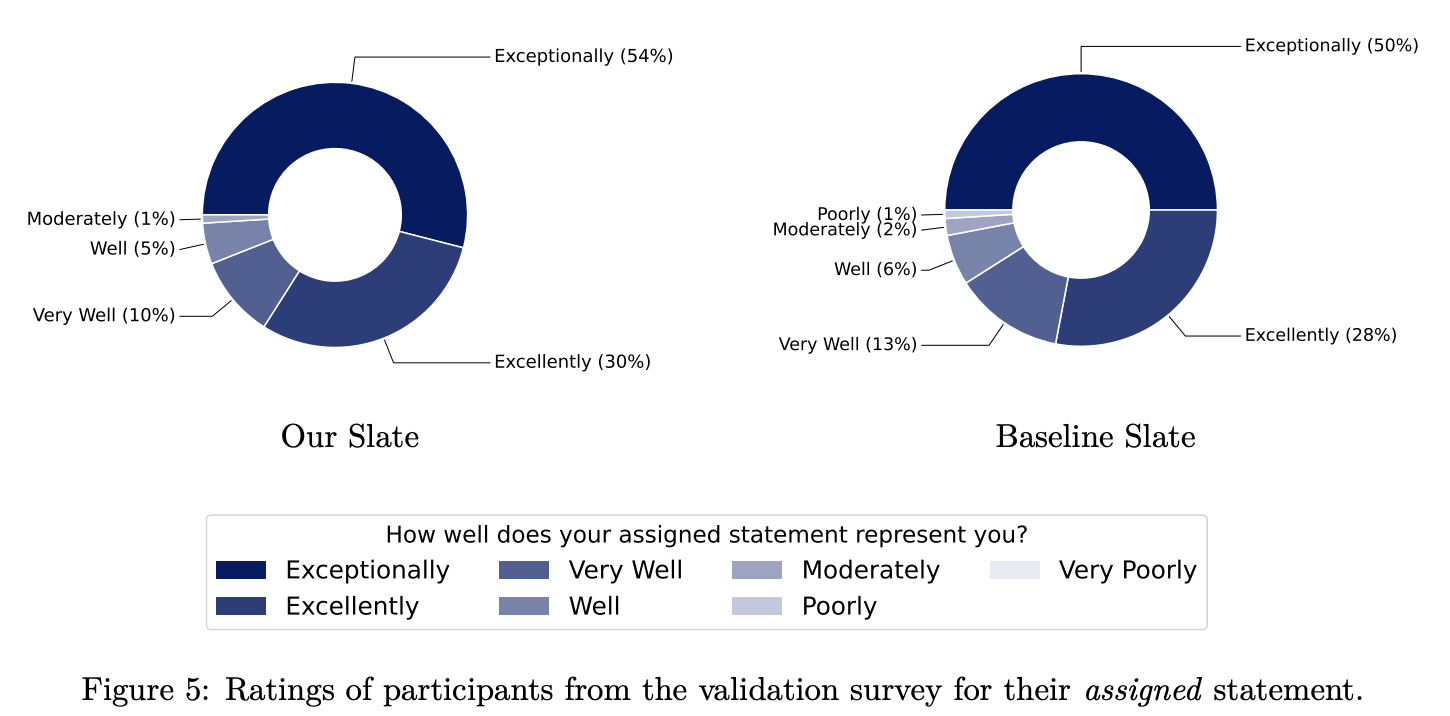
Methods: The authors first develop an algorithm that makes discriminative queries (“asks” about people’s preferences) to discern user’s utility function, and generative queries to maximize utility among groups of participants, i.e. to represent groups. They then approximate this process with real participants using GPT-4. In an experiment on abortion policy in the US, participants expressed opinions in their own words; the model then grouped similar people, generated representative statements for each group, and produced a final set of statements meant to reflect everyone’s views. Most participants said the results captured their opinions well.
Why it matters: It is very important to connect the ideas around LLMs and summarization of opinions to the theoretical framework of social choice if we want them to be used and understood in broader contexts.
Fair sortition algorithms
After these AI-driven tools, let’s zoom out to selecting participants fairly. I recently finished a Stanford course on ethics and tech policy, which got me thinking about how general tech-ethics questions apply to deliberative tools. One of the most fascinating areas here is fair sortition algorithms. So let’s look at two papers exploring this idea.
Fair algorithms for selecting citizens’ assemblies
Bailey Flanigan, Paul Gölz, Anupam Gupta, Brett Hennig & Ariel D. Procaccia.
Context: this paper explains how randomness doesn’t mean complete fairness, and why there’s a tension between equality and representativeness. It proposes a selection algorithm (a procedure to choose k people from a pool of n volunteer candidates) to deal with this problem.
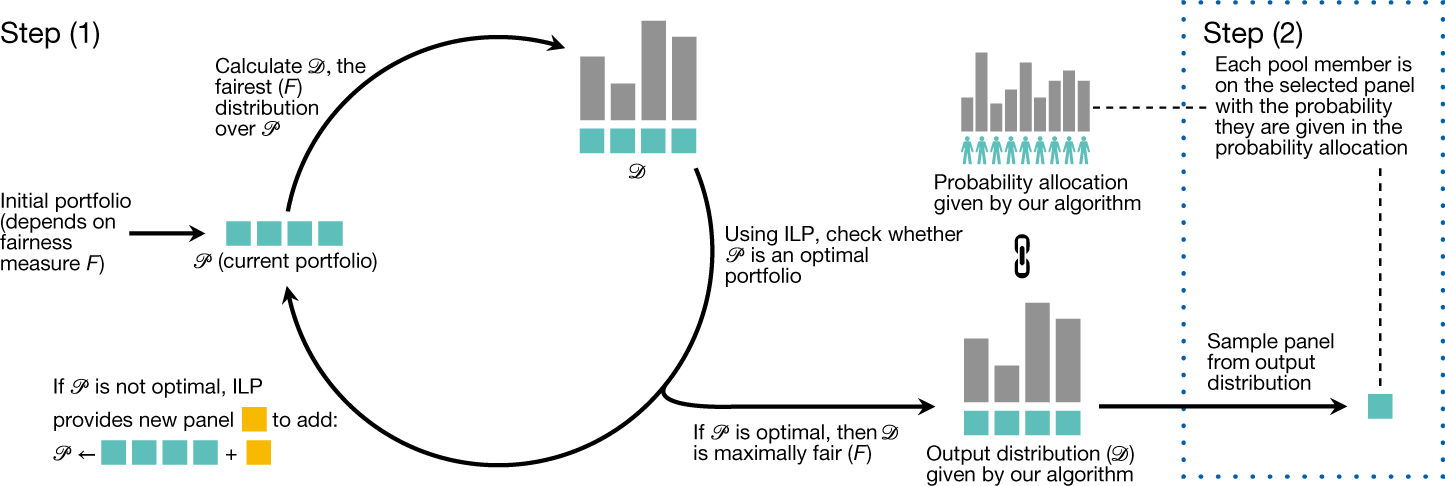
Methods: Normally, selection algorithms are concerned with just satisfying quotas. But the authors show that this approach forces near-zero chances to be selected on some demographic groups in the self-selected pool (volunteers with many overrepresented features).
They describe an assembly selection algorithm that strives to make probabilities of selection as equal as possible, subject to the quotas. This algorithm (1) computes a maximally fair output distribution and then (2) samples from that distribution to select the final panel.
Fans of algorithms and computer science should also check out this newer paper proposing another algorithm, and this one on replacing drop-outs from assemblies.
Sortition and its Principles: Evaluation of the Selection Processes of Citizens’ Assemblies
Adela Gąsiorowska.
Context: A review of how 29 citizens’ assemblies in Europe live up to the ideals of fairness, randomness, representativeness, and equality of selection.
Methods: The author analyzed assemblies across nine European countries using desk research of publicly-available reports, methodology documents and member-data. She constructed an evaluation model that split the selection process into three stages (initial composition, invitation/selection to participate, final selection of members) and assessed each stage for how well it implemented the principles of randomness, representation and equality. For each principle and stage the assembly could score up to two points, depending on whether the principle was implemented fully or only partially.
Key take-aways: The results are rather sobering: a large share of assemblies falls short on fairness criteria. Most assemblies did well on representation, but the principles of random selection and equality of opportunity were often broken. That’s understandable to some extent: ills such as patchy records and the tension between representativeness and equality of chances are very hard to fight. But if CAs want to claim democratic legitimacy on the basis of sortition, then this needs to be addressed. One thing to do is to use better sortition algorithms.
Thank you for reading! Leave a comment, and see you next month.
Maria
Opportunities:
The Oxford Computational Political Science Group is looking for Research Associates for its Research Programme. 🗓 Application Deadline: November 23, 2025. Apply here
Ethics and Technology Practitioner Fellowship at Stanford. 🗓 Application Deadline: December 14, 2025. Apply here
Mentorship Program at Technologists for the Public Good is open for mentors and mentees. 🗓 Application Deadline: December 5, 2025. Apply here
Winter 2026 Software Engineering Fellowship. 🗓 Application Deadline: November 16, 2025. Apply here
Creative Bureaucracy Festival in Berlin. 🗓 Application Deadline: 5 December, 2025. Apply here
Open Call for Fellowship Applications at The Berkman Klein Center for Internet & Society. 🗓 Application Deadline: December 5, 2025. Apply here